The AI Revolution in 2026: What No One Is Telling You
By Alexandre Silveira · March 20, 2026 · Updated on March 23, 2026
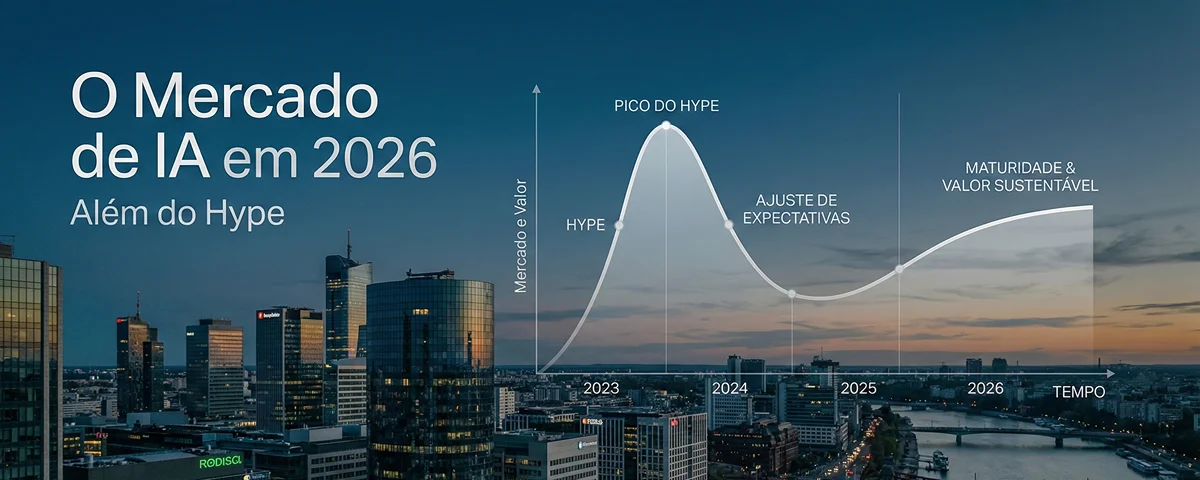
Artificial intelligence is no longer a promise — it has become infrastructure. In less than four years, AI-powered tools have moved from research labs to the center of strategic decision-making across companies, content creators, and governments. What started as curiosity has turned into a full-scale corporate race.
But while everyone talks about innovation, automation, and exponential productivity, few are discussing the side effects of the accelerated growth of the AI market in 2026.
This is not another article about “how to write better prompts.” This is an analysis of what’s happening behind the hype — and why understanding it now can position you years ahead.
The AI Market in 2026: Real Growth or Inflated Growth?
Growth is undeniable. Since the launch of ChatGPT, AI adoption has skyrocketed across industries — from customer service and marketing to data analysis, HR, and even legal departments.
But rapid growth does not mean maturity.
👉 Check out our ChatGPT analysis
The Post-ChatGPT Boom
After the rise of generative AI, nearly every company started positioning itself as “AI-driven.”
Legacy software got rebranded
Startups emerged promising full automation
Investors began funding anything with “AI” in the pitch
The problem: many of these solutions are not truly advanced AI — they are well-marketed automation tools.
The Corporate FOMO Effect
FOMO (Fear of Missing Out) has become a corporate strategy.
CEOs fear falling behind
Executives pressure teams to “implement AI”
Professionals are hired as “AI experts” without real experience
The question almost no one asks:
AI implemented to solve what problem?
Inflated Metrics and Artificial Valuations
In 2026, we are already seeing classic signs of an overheated market:
Overvalued startups
Exponential growth promises without solid foundations
Heavy dependence on external funding
This doesn’t mean AI is a bubble — but there is clearly a narrative bubble.
Content Saturation: Everyone Talks About AI, Few Understand It
If you consume tech content, you’ve noticed: it’s nearly impossible to scroll through social media without seeing “how to make money with AI.”
The Generic Content Epidemic
Repetitive tutorials
Shallow lists
Copied prompts
Instant “experts”
The result: more information, less depth.
The market is full of tool operators — but lacks strategists.
The Artificial Authority Paradox
People who started using AI weeks ago teach as if they were pioneers.
This creates a dangerous signal:
beginners can’t distinguish real expertise from personal branding.
In 2026, authority isn’t who talks the most — it’s who understands the limits.
The New Differentiator: Context and Curation
The professionals who stand out are not those producing more AI content, but those who:
Contextualize
Integrate
Apply with critical thinking
Volume lost value. Strategy gained it.
False Productivity: When AI Only Seems to Increase Results
One of AI’s biggest promises is productivity. And yes, it accelerates processes — but speed is not the same as results.
Producing More Is Not Producing Better
Today you can create:
Articles
Scripts
Images
Campaigns
All in hours.
But quality and differentiation still depend on human strategy.
The internet is already feeling the impact: more content, less depth.
The One-Click Illusion
Viral prompts promise “guaranteed results.”
Without context, audience understanding, and strategy, the outcome is generic.
AI amplifies capability — it doesn’t replace judgment.
The Hidden Cost
What many don’t account for:
Rework
Manual adjustments
Continuous revisions
Tone alignment
Fact corrections
Initial productivity is often followed by a refinement phase that takes longer than expected.
Tool Dependency: The New Digital Illiteracy
There’s a fundamental difference between:
Using a tool
Understanding how it works
Operator vs Strategist
The operator depends on the interface
The strategist understands logic, flow, and integration
If a tool changes policies, limits access, or raises prices — the operator is exposed.
The Risk of Centralization
Companies relying on a single AI solution face operational risks.
Changes in APIs, pricing, or usage policies can directly impact the business.
In 2026, tool dependency is a strategic risk.
The Skill That Survives
Critical thinking
Adaptability
Conceptual understanding
Tools change. Fundamentals remain.
The Illusion of Full Automation
The dominant narrative suggests companies will run almost entirely on AI.
Reality is more complex.
Partial Automation ≠ True Autonomy
Automating repetitive tasks is efficient.
Delegating strategic decisions is another story.
AI does not understand:
Internal politics
Organizational culture
Emotional nuance
Where AI Still Fails
Deep cultural interpretation
Consistent strategic tone
Ethical decision-making
Crisis management
AI processes patterns. Humans process meaning.
The Future Is Hybrid
The sustainable model is not “AI replaces humans” but:
AI enhances humans
Smaller teams
More strategic roles
Supported by intelligent systems
What Will Actually Differentiate Professionals in 2026
Access to AI is no longer the advantage.
What matters now:
Strategic thinking
Tool integration
Personal branding
Vertical specialization
What Companies Still Don’t Understand About AI
Many leaders believe technology will fix structural problems.
It won’t.
AI does not fix:
Poor organizational culture
Weak leadership
Broken processes
Lack of strategy
It amplifies what already exists.
Implementing AI without structure accelerates chaos.
Signs You’re Falling Into the Hype
Switching tools every week
Consuming excessive tutorials
High output, low results
Constant urgency
Continuous comparison
Hype creates anxiety. Strategy creates direction.
Realistic Predictions Until 2028
Consolidation of major players
Decline of superficial startups
Stronger regulations
Hybrid professionals dominating strategic roles
Less noise, more practical application
The market is moving from experimental to structural.
Conclusion: The Post-Hype Era
Artificial intelligence is not a trend. It is already part of global digital infrastructure.
The question in 2026 is no longer:
“Do you use AI?”
The real question is:
“Do you understand how it impacts your business model?”
The AI market will not be defined by those who produce more content, but by those who create more clarity.
Tools will evolve. Platforms will rise and fall.
But strategic thinking, long-term vision, and strong positioning remain rare assets.
And rare assets build authority.
Final Insight
In 2026, winners are not those who use AI.
They are the ones who understand why they use it.
Sources and Further Reading
McKinsey – AI Insights & Reports
PwC – Artificial Intelligence Studies
Gartner – AI Market Trends
World Economic Forum – AI Reports
OpenAI Research
Google AI Research